HISTORY OF THE OLD WINDSOR
Updated June 2021
PARISH MAGAZINE - April 1900
Baptisms
Feb 23rd Richard William, son of Richard and Jane Curtis*
Mar 4th Margery Alice Eva daughter of William and Mary Jane Knight (Windsor Park)
Mar 18th David John son of Joseph and Sarah Caroline Tindall
18th Frederick Arthur son of John William and Mary Ann Pullin.
Burials
Feb 28th Richard William Curtis, aged one month*
Mar 24th Joseph Pope aged 74 years
* It is sad to note that Richard William Curtis was baptised and died within the same week.
Mr Joseph Pope and his family have an interesting history. Married in c1847 to Mary Kemp who was older than Joseph, it is amusing to find the gap between their ages alters with each census report. In 1851 he is 25 and Mary is 26. In 1861, that gap is now three years, but by 1881 the gap has widened considerably, Joseph is listed as 56, and Mary is 63. In census report of 1891, they are 65 and 70 years of age respectively. In fact, the gap is about two or three years.
Between their marriage in c1847 and the birth of their last child, Emily in c1863, Mary and Joseph had six surviving* children:
James c1849
William c1852
Mary Ann c1854
Joseph c1856
Elizabeth c1859
Emily c1863
(*deeper research into the records is required to find if any children were born and died between each census report)
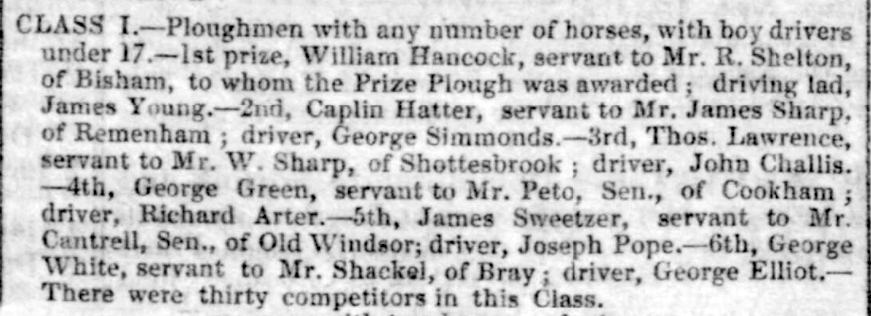
In 1851, the Reading Mercury report of the Royal East Berkshire Agricultural Show mentions Joseph taking part in one of the ploughing competitions; Class 1- Ploughmen with any number of horses, with boy drivers under 17. Joseph was 15 years of age, and his team came fifth out of thirty competitors.
Feb 23rd Richard William, son of Richard and Jane Curtis*
Mar 4th Margery Alice Eva daughter of William and Mary Jane Knight (Windsor Park)
Mar 18th David John son of Joseph and Sarah Caroline Tindall
18th Frederick Arthur son of John William and Mary Ann Pullin.
Burials
Feb 28th Richard William Curtis, aged one month*
Mar 24th Joseph Pope aged 74 years
* It is sad to note that Richard William Curtis was baptised and died within the same week.
Mr Joseph Pope and his family have an interesting history. Married in c1847 to Mary Kemp who was older than Joseph, it is amusing to find the gap between their ages alters with each census report. In 1851 he is 25 and Mary is 26. In 1861, that gap is now three years, but by 1881 the gap has widened considerably, Joseph is listed as 56, and Mary is 63. In census report of 1891, they are 65 and 70 years of age respectively. In fact, the gap is about two or three years.
Between their marriage in c1847 and the birth of their last child, Emily in c1863, Mary and Joseph had six surviving* children:
James c1849
William c1852
Mary Ann c1854
Joseph c1856
Elizabeth c1859
Emily c1863
(*deeper research into the records is required to find if any children were born and died between each census report)
In 1851, the Reading Mercury report of the Royal East Berkshire Agricultural Show mentions Joseph taking part in one of the ploughing competitions; Class 1- Ploughmen with any number of horses, with boy drivers under 17. Joseph was 15 years of age, and his team came fifth out of thirty competitors.
By 1851, Joseph was married and living and working at Tileshott Farm with Mary his wife, and James their two years old son. In 1856, Joseph was in trouble with the law. Joseph and a man named William Eggleton were charged with the theft of a sack of barley, and John Arthur was charged with receiving it. It was the property of Mr Richard Russell who had employed Joseph and William to thrash corn. There were several witnesses, and the case was reported in the Windsor and Eton Express. All three men were found guilty. The Judge stated that it was a ‘most serious offence’ and he believed they did it ‘in order to indulge in the vicious habit of drinking’. Joseph and William were each sentenced to six months’ hard labour. John Arthur was deemed to be an even worse offender. The Judge stated that ‘if there were no receivers, there would be but few thieves’ as receivers encouraged theft, he felt ‘bound to deal severely in these cases’. Arthur was sentenced to one-year hard labour.
That wasn’t the end of the family’s brush with the law. Between Christmas 1887 and New Year 1888, Joseph Pope junior (born in 1856) was involved in a terrible fight with his brother-in-law, George Minall. Both had dinner with William Pope (Joseph’s brother) at his home, when Joseph awoke and threatened to kill Minall’s wife. After punches were thrown, Joseph pulled a knife. Minall struck Joseph with a belt, Joseph kicked Minall and struck him with the knife. William removed his brother from the house, and the Minall couple remained locked indoors all night which periodically Joseph was outside threatening to kill them. The newspaper reported Minall stating that Joseph threatened ‘he had been tried for murder once, but he be hung for them this time’. After a deal of window breaking, fighting, and brawling, where Minall also made threats of violence. Joseph was arrested while drinking at The Oxford Man by PC Phillips who noted ‘scars on his breast and on his leg’. The constable did not know the cause of the fight.
‘The Magistrates ordered the defendant to enter into his own recognisance to keep the peace for six months’.
Did Joseph get a light sentence? Possibly. One of the Magistrates was F Ricardo Esq of Old Windsor, who may have had pertinent knowledge of the family, their situation, and any disputes within their ranks.
On Saturday October 23rd 1897, the Windsor and Eton Express reported the Golden Wedding of Mr and Mrs Joseph Pope, who were living in the Almshouses. They were long time residents of Old Windsor and the paper reported the couple had ‘brought up a large family, the whole of whom are respectable citizens’.
This month’s magazine covered Holy Week, and there are listed the times and places of the extra services being held. The Vicar writes:
‘Oh that the number of those in our parish who will follow our Blessed Lord in devout remembrance to His Cross and Grave…may be far greater than it has ever been before.’
Confirmation
Twelve young people were confirmed in the Windsor Parish Church, the majority having regularly attended classes. The vicar says the parish must ‘earnestly entreat their parents and those in whose charge they nay be, to do all they can to help and encourage them to lead a prayerful and Christian life.’
Sadly, no list of names is given of those confirmed.
Children’s Dinners
Miss Weir, at the Murray Convalescent Home, was praised for her good work in providing children from the village with ‘penny dinners’ on weekdays. The provision of these meals had started in January, generally consisting of soup and pudding, and attendance was good, often with 27 children enjoying the ‘warming and satisfying’ meal.
The War
The clothing made the Women’s Help Society was passed to Mrs Dickinson, wife of the Colonel of the Royal Berkshire Regiment for the men fighting in South Africa. Lady Dunboyne bought a large stock of flannel, wool, and other materials, and there were plenty of volunteers to make more clothes.
The Relief of Ladysmith is reported with ‘thankfulness and delight’, and with it the hope that ‘the War may be brought to a successful termination.’
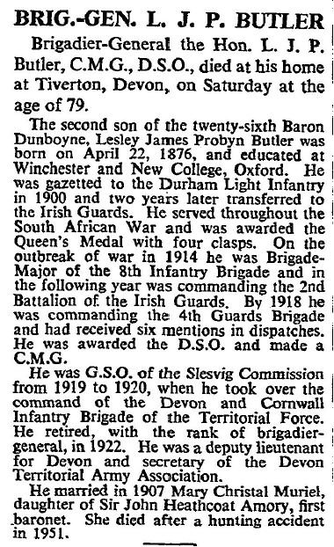
Note was made of the fact that the Honourable Lesley James Probyn Butler was gazetted as Lieutenant in the 1st Durham Light Infantry. He was believed to be serving under General Buller. Lt Butler was the second son of Lord and Lady Dunboyne who were active within the Old Windsor church and community. Lt Butler had an outstanding military career, raising to the rank of Brigade General. He served in both the South African war and in the First World War. He was married for over forty years and died in 1955.
That wasn’t the end of the family’s brush with the law. Between Christmas 1887 and New Year 1888, Joseph Pope junior (born in 1856) was involved in a terrible fight with his brother-in-law, George Minall. Both had dinner with William Pope (Joseph’s brother) at his home, when Joseph awoke and threatened to kill Minall’s wife. After punches were thrown, Joseph pulled a knife. Minall struck Joseph with a belt, Joseph kicked Minall and struck him with the knife. William removed his brother from the house, and the Minall couple remained locked indoors all night which periodically Joseph was outside threatening to kill them. The newspaper reported Minall stating that Joseph threatened ‘he had been tried for murder once, but he be hung for them this time’. After a deal of window breaking, fighting, and brawling, where Minall also made threats of violence. Joseph was arrested while drinking at The Oxford Man by PC Phillips who noted ‘scars on his breast and on his leg’. The constable did not know the cause of the fight.
‘The Magistrates ordered the defendant to enter into his own recognisance to keep the peace for six months’.
Did Joseph get a light sentence? Possibly. One of the Magistrates was F Ricardo Esq of Old Windsor, who may have had pertinent knowledge of the family, their situation, and any disputes within their ranks.
On Saturday October 23rd 1897, the Windsor and Eton Express reported the Golden Wedding of Mr and Mrs Joseph Pope, who were living in the Almshouses. They were long time residents of Old Windsor and the paper reported the couple had ‘brought up a large family, the whole of whom are respectable citizens’.
This month’s magazine covered Holy Week, and there are listed the times and places of the extra services being held. The Vicar writes:
‘Oh that the number of those in our parish who will follow our Blessed Lord in devout remembrance to His Cross and Grave…may be far greater than it has ever been before.’
Confirmation
Twelve young people were confirmed in the Windsor Parish Church, the majority having regularly attended classes. The vicar says the parish must ‘earnestly entreat their parents and those in whose charge they nay be, to do all they can to help and encourage them to lead a prayerful and Christian life.’
Sadly, no list of names is given of those confirmed.
Children’s Dinners
Miss Weir, at the Murray Convalescent Home, was praised for her good work in providing children from the village with ‘penny dinners’ on weekdays. The provision of these meals had started in January, generally consisting of soup and pudding, and attendance was good, often with 27 children enjoying the ‘warming and satisfying’ meal.
The War
The clothing made the Women’s Help Society was passed to Mrs Dickinson, wife of the Colonel of the Royal Berkshire Regiment for the men fighting in South Africa. Lady Dunboyne bought a large stock of flannel, wool, and other materials, and there were plenty of volunteers to make more clothes.
The Relief of Ladysmith is reported with ‘thankfulness and delight’, and with it the hope that ‘the War may be brought to a successful termination.’
Note was made of the fact that the Honourable Lesley James Probyn Butler was gazetted as Lieutenant in the 1st Durham Light Infantry. He was believed to be serving under General Buller. Lt Butler was the second son of Lord and Lady Dunboyne who were active within the Old Windsor church and community. Lt Butler had an outstanding military career, raising to the rank of Brigade General. He served in both the South African war and in the First World War. He was married for over forty years and died in 1955.
Click below to access previous extracts from copies of the Parish magazine from 120 years ago:

| 21.6.9_archive_of_the_parish_magazine_from_120_years_ago.pdf |
History of the Parish Church
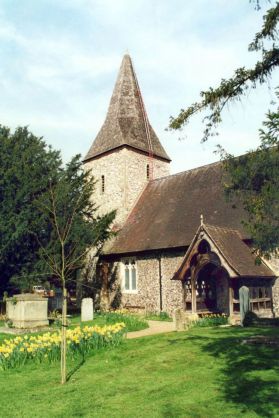
The Parish Church of St Peter and St Andrew was probably built on the site of the chapel attached to King Edward the Confessor’s hunting lodge, and it is possible that it was the king who added his favourite saint, Saint Peter, to an original dedication to St Andrew. Several synods or meetings of bishops took place here in the early days.
After King John had been obliged to set his seal to Magna Carta in 1215, mercenary French soldiers came through Old Windsor and destroyed the church, which may have been mainly built of wood. The church was rebuilt in 1218 and had thick walls and small windows. During medieval times some of these windows were replaced with larger ones.
In Georgian times, the church had a stone porch, in which weddings were sometimes celebrated, and on the tower was a small cupola. An avenue of larch trees, of which some stumps can still be seen, led to the north door. As wealthy families moved into the village, bringing their servants, there was not enough room in church and a gallery was built at the west end to accommodate the children. However, as they were badly behaved it was necessary to appoint a beadle to keep them in order. The church contained many large memorials.
By 1865 restoration was needed and the architect Giles Gilbert Scott carried out an extensive plan, removing the porch, the gallery and the three-decker pulpit, and installing the rood screen, pews and choir vestry which we have today. The spire was built to replace the cupola. Three extra bells were added to the five dating from 1775, to make the ring up to eight bells.
Subsequently, restoration campaigns have resulted in the replacement of much of the damaged stonework around the windows and on the tower. The spire has also been re-shingled several times. The church suffered a serious fire on Easter Day 2008 but has now been fully restored.
After King John had been obliged to set his seal to Magna Carta in 1215, mercenary French soldiers came through Old Windsor and destroyed the church, which may have been mainly built of wood. The church was rebuilt in 1218 and had thick walls and small windows. During medieval times some of these windows were replaced with larger ones.
In Georgian times, the church had a stone porch, in which weddings were sometimes celebrated, and on the tower was a small cupola. An avenue of larch trees, of which some stumps can still be seen, led to the north door. As wealthy families moved into the village, bringing their servants, there was not enough room in church and a gallery was built at the west end to accommodate the children. However, as they were badly behaved it was necessary to appoint a beadle to keep them in order. The church contained many large memorials.
By 1865 restoration was needed and the architect Giles Gilbert Scott carried out an extensive plan, removing the porch, the gallery and the three-decker pulpit, and installing the rood screen, pews and choir vestry which we have today. The spire was built to replace the cupola. Three extra bells were added to the five dating from 1775, to make the ring up to eight bells.
Subsequently, restoration campaigns have resulted in the replacement of much of the damaged stonework around the windows and on the tower. The spire has also been re-shingled several times. The church suffered a serious fire on Easter Day 2008 but has now been fully restored.
|
|
History of St Luke's
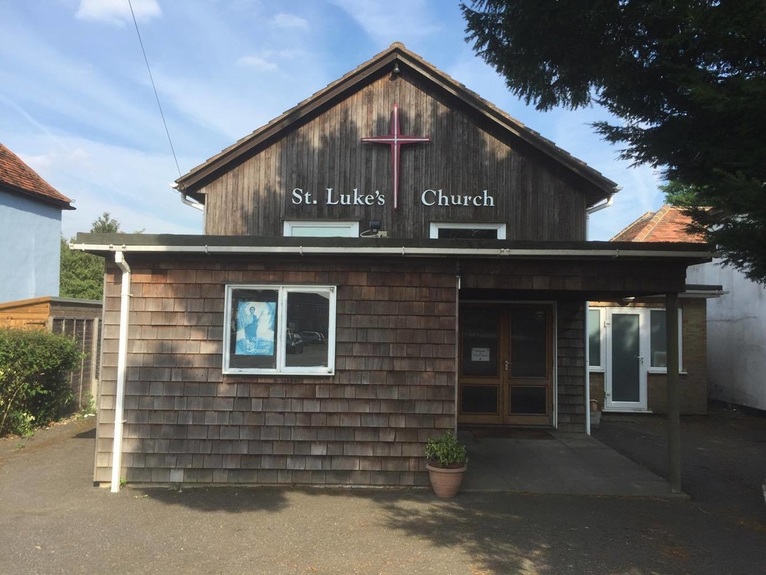
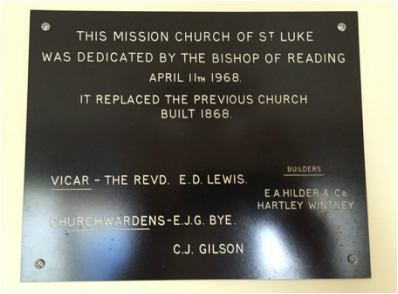
The old St. Luke’s was built in 1867 at the instigation of Lady Blunt the wife of the Vicar of the time. It was a brick building with one side aisle. The chancel area could be separated from the body of the church by drawing a velvet curtain when the church was being used for social activities.
In the side aisle stood the big table which is now in the Parish Church vestry, and the village library was kept in two bookcases, and presided over by Mrs. Marston the Churchwarden’s wife and former Infant School headmistress.
When it became obvious that it would be better to build a new church rather than attempt to repair the old one the churchwardens looked at possible buildings. The one chosen was similar to the small church at Braywick, and was a prefabricated building. As it is wooden, planning law required a space around it, so the kitchen and committee room were built in brick so that they could go closer to the boundary.
Then came the choice of furnishings. By far the most illustrious item in St. Luke’s is not what you would guess – it is the carpet. In 1960, Westminster Abbey sold off all the carpet which had been in the Abbey for the Coronation, some gold and some blue. The PCC bought a piece of blue carpet and put it in the chancel of the old St. Luke’s. For the new building it was cut in half and relaid behind the altar – you can see the seam.
It was decided that the capacity of the building was 80, and there were 80 people there when it was dedicated. The next thing to move into St. Luke’s was the altar table. This had been in the Parish Church – inside the main door, used for hymn books, but it never fitted in well being light oak where all else was dark. It was a memorial to Mr. William Ellis the village schoolmaster – and also organist and choirmaster who died in 1961. His daughter Miss Ellis was happy to have it used as the altar in St. Luke’s.
The altar rails were given by Miss Reddick a long time resident of Old Windsor. She commissioned them and had them specially made in the Great Park workshops from oak from the Park, and they are a memorial to Rev. Harwood who was for many years the much loved vicar of the parish. The lectern was the gift of the Lacey family in memory of their parents, and the Credence table was the gift of the Mothers Union – at one time a flourishing group in the church.
There are 75 kneelers – or should they be called that? Mrs. Marston said to me severely, “They are not kneelers, kneelers are those who kneel – these are hassocks.” Whatever you call them, they were embroidered by many people and portray many of the organisations active in the village. Each contains a card recording details of the maker, with a short biography in some cases. This information is also recorded in a “Kneeler Book.”
St Luke's is fitted with a wide range of audio-visual facilities, and can be used in different layouts and for a wide variety of purposes. The kitchen was completely renovated in 2009.
In the side aisle stood the big table which is now in the Parish Church vestry, and the village library was kept in two bookcases, and presided over by Mrs. Marston the Churchwarden’s wife and former Infant School headmistress.
When it became obvious that it would be better to build a new church rather than attempt to repair the old one the churchwardens looked at possible buildings. The one chosen was similar to the small church at Braywick, and was a prefabricated building. As it is wooden, planning law required a space around it, so the kitchen and committee room were built in brick so that they could go closer to the boundary.
Then came the choice of furnishings. By far the most illustrious item in St. Luke’s is not what you would guess – it is the carpet. In 1960, Westminster Abbey sold off all the carpet which had been in the Abbey for the Coronation, some gold and some blue. The PCC bought a piece of blue carpet and put it in the chancel of the old St. Luke’s. For the new building it was cut in half and relaid behind the altar – you can see the seam.
It was decided that the capacity of the building was 80, and there were 80 people there when it was dedicated. The next thing to move into St. Luke’s was the altar table. This had been in the Parish Church – inside the main door, used for hymn books, but it never fitted in well being light oak where all else was dark. It was a memorial to Mr. William Ellis the village schoolmaster – and also organist and choirmaster who died in 1961. His daughter Miss Ellis was happy to have it used as the altar in St. Luke’s.
The altar rails were given by Miss Reddick a long time resident of Old Windsor. She commissioned them and had them specially made in the Great Park workshops from oak from the Park, and they are a memorial to Rev. Harwood who was for many years the much loved vicar of the parish. The lectern was the gift of the Lacey family in memory of their parents, and the Credence table was the gift of the Mothers Union – at one time a flourishing group in the church.
There are 75 kneelers – or should they be called that? Mrs. Marston said to me severely, “They are not kneelers, kneelers are those who kneel – these are hassocks.” Whatever you call them, they were embroidered by many people and portray many of the organisations active in the village. Each contains a card recording details of the maker, with a short biography in some cases. This information is also recorded in a “Kneeler Book.”
St Luke's is fitted with a wide range of audio-visual facilities, and can be used in different layouts and for a wide variety of purposes. The kitchen was completely renovated in 2009.
|
|
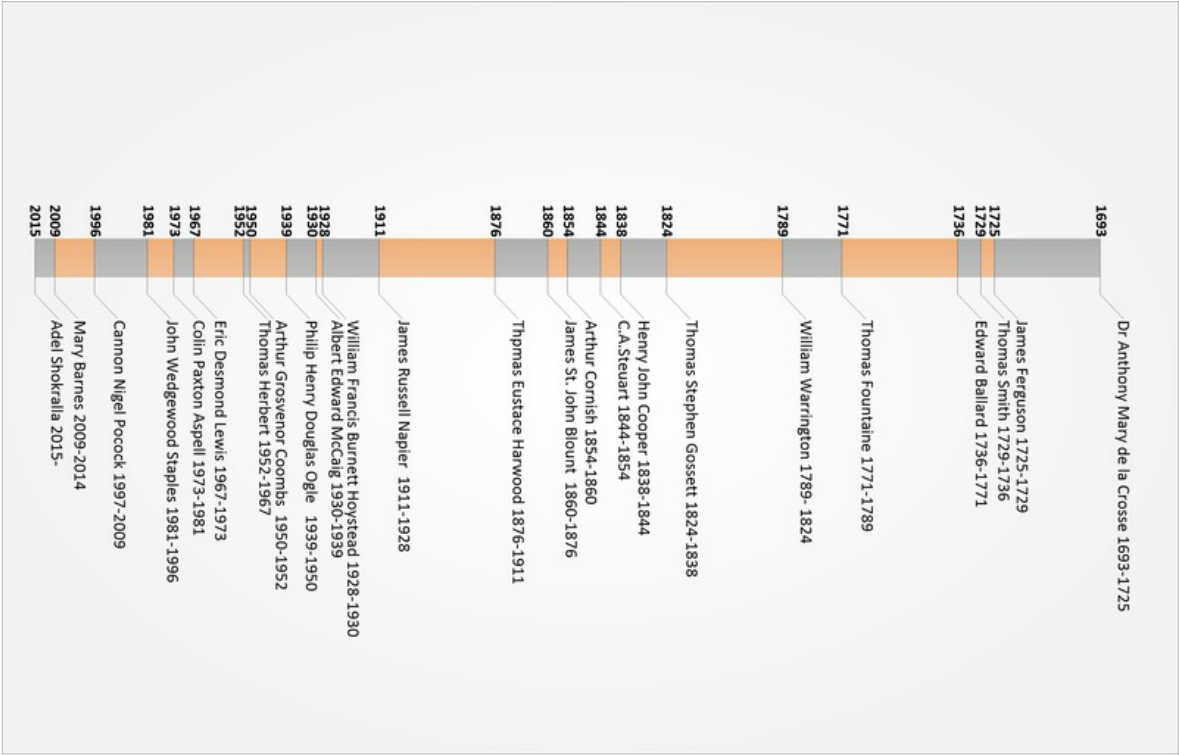
Vicars of Old Windsor Church Parish
1693 - 2015
Old Windsor
From Saxon Times To Present Day
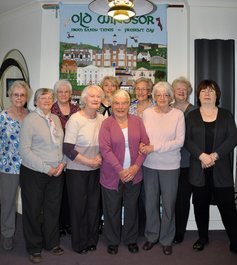
Thank you so much to Old Windsor sewing group who have worked for 3 years on this hand-stitched panel, which will be hung in the Parish Church from Thursday 25th May.
They are following in a long tradition in Old Windsor. From 1875 till the early years of the 20th century high quality wall hangings were stitched and woven at “The Tapestries” on Straight Road. Queen Victoria was a patron and some of the work commissioned by her and other members of the royal family are still hanging in Windsor Castle and Hollyrood House. So our local needlework group are keeping alive the Old Windsor tradition, and we hope this beautiful panel, showing features of our own village, will be here for many years, giving pleasure to generations to come. |
|